
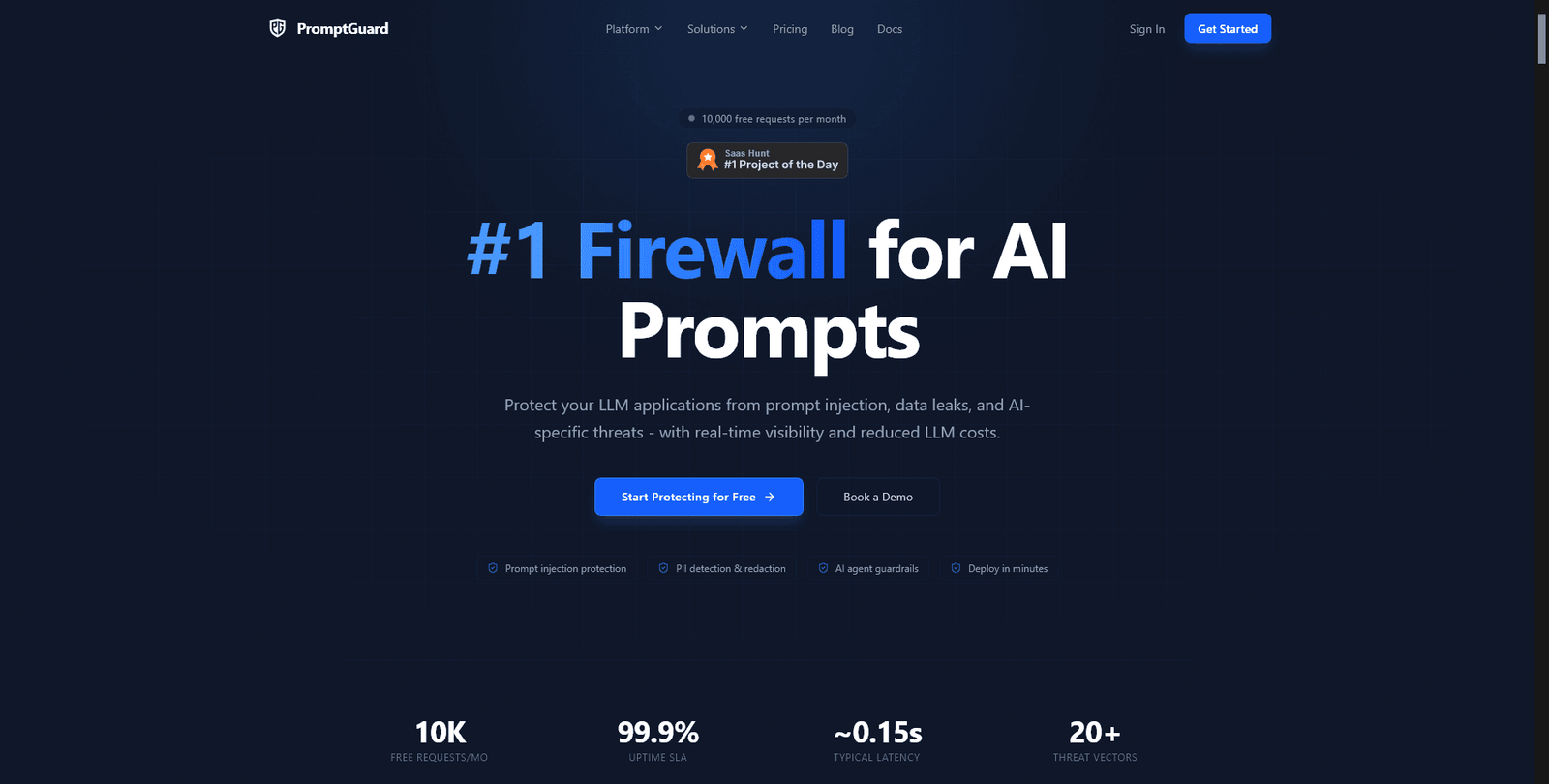
What if your AI assistant could be manipulated into leaking sensitive data or ignoring safety rules? PromptGuard aims to stop that before it happens. This real-time prompt firewall protects LLM applications with prompt injection detection, PII redaction, and AI governance tools designed for modern enterprise workflows. In this review, we break down PromptGuard’s features, pricing, strengths, limitations, and whether it’s the right security layer for production AI systems.
Overview
PromptGuard is an AI security layer designed to protect large language model (LLM) applications from prompt injection attacks, data leakage, and unsafe prompt handling. Positioned as a “real-time prompt firewall,” the platform inspects incoming prompts and contextual data before requests reach an AI model.
The tool focuses on enterprise-grade AI governance by sanitizing prompts, redacting personally identifiable information (PII), enforcing security policies, and detecting malicious prompt behavior in real time. PromptGuard is built for organizations deploying generative AI into customer-facing workflows, internal copilots, or API-driven automation systems.
As AI adoption accelerates, prompt-layer security has become a growing concern. PromptGuard addresses this by acting as an intermediary layer between users and LLM providers such as OpenAI, Anthropic, Google Gemini, Azure OpenAI, and Groq.
What Is PromptGuard?
PromptGuard is a middleware security platform for AI applications. Instead of replacing an LLM, it operates alongside existing AI infrastructure to inspect and modify prompts before they reach the model.
The platform is designed to:
- Detect prompt injection attempts
- Remove or mask sensitive information
- Prevent unintended data exposure
- Enforce organizational prompt policies
- Monitor AI interactions for compliance and auditing
The product appears particularly suited for regulated industries, enterprise SaaS products, and AI-enabled support systems where data handling and governance are critical.
Key Features
Real-Time Prompt Inspection
PromptGuard evaluates prompts and surrounding context before requests are processed by the target LLM. This enables teams to identify suspicious instructions or malicious prompt manipulation attempts in real time.
Common threat patterns include:
- Jailbreak attempts
- System prompt extraction
- Role manipulation
- Context poisoning
- Instruction overrides
The real-time nature of the platform makes it suitable for customer-facing AI applications where unsafe prompts can emerge unpredictably.
Prompt Injection Protection
One of PromptGuard’s primary use cases is defending against prompt injection attacks.
These attacks attempt to manipulate an LLM into:
- Ignoring system instructions
- Revealing hidden prompts
- Accessing sensitive information
- Producing unsafe or restricted outputs
PromptGuard uses heuristics, machine learning classifiers, and LLM-based detection mechanisms to identify suspicious prompt behavior before execution.
This layered approach may improve detection coverage compared to rule-based filtering alone.
PII Redaction
The platform can redact or sanitize sensitive user information before prompts reach the AI model.
Supported data types may include:
- Email addresses
- Phone numbers
- Names
- Financial information
- Authentication tokens
- Internal identifiers
For organizations handling regulated data, this functionality helps reduce the risk of exposing confidential information to third-party AI providers.
Policy Enforcement
PromptGuard allows teams to define security policies that govern how prompts are processed.
Examples include:
- Blocking specific prompt patterns
- Restricting sensitive keywords
- Preventing unauthorized context sharing
- Enforcing compliance workflows
This adds an operational governance layer that many native LLM APIs currently lack.
Logging and Analytics
The platform includes observability features for monitoring prompt activity and security incidents.
Teams can potentially use logs and analytics for:
- Threat monitoring
- Compliance reporting
- AI governance audits
- Incident investigations
- Prompt optimization analysis
This visibility is especially useful for enterprise AI deployments where traceability matters.
Multi-Provider Compatibility
PromptGuard supports multiple AI providers and infrastructure environments, including:
- OpenAI
- Anthropic
- Google Gemini
- Azure OpenAI
- Groq
This flexibility makes it easier for organizations to integrate security controls across heterogeneous AI stacks.
User Experience
PromptGuard positions itself as a “drop-in” firewall layer, suggesting relatively lightweight integration into existing AI pipelines.
The overall value proposition is strongest for development teams that:
- Already use production AI systems
- Need centralized AI governance
- Require compliance visibility
- Handle customer or regulated data
The platform’s technical orientation means it is likely better suited for developers, security teams, and enterprise IT departments rather than casual AI users.
PromptGuard Use Cases
Enterprise AI Assistants
Organizations deploying internal copilots can use PromptGuard to prevent employees from unintentionally exposing confidential information through prompts.
Customer Support Automation
AI-powered support systems often process sensitive customer data. PromptGuard can help sanitize prompts before they reach external AI APIs.
Regulated Industries
Healthcare, finance, legal, and insurance organizations may benefit from PII filtering and prompt governance controls.
API-Based AI Products
SaaS companies integrating generative AI into customer workflows can use PromptGuard to reduce the risk of abuse and malicious prompt manipulation.
Pros and Cons
Pros
- Focused specifically on AI prompt-layer security
- Real-time prompt inspection capabilities
- Prompt injection detection support
- PII redaction and sanitization tools
- Multi-provider LLM compatibility
- Enterprise governance and logging features
- Freemium availability lowers evaluation barrier
Cons
- Limited publicly available technical documentation
- Detection accuracy metrics are not extensively published
- May require security expertise for optimal policy configuration
- Enterprise-focused positioning may exceed small-team needs
- Integration complexity depends on existing AI architecture
Pricing
| Plan | Pricing Model | Notes |
|---|---|---|
| Free Tier | Freemium | Entry-level access available |
| Enterprise | Custom Pricing | Likely includes advanced governance, analytics, and policy management |
For current pricing details, organizations should consult the official vendor website.
PromptGuard vs Alternatives
| Platform | Primary Focus | Strength |
|---|---|---|
| PromptGuard | Prompt firewall & AI governance | Real-time prompt sanitization |
| Lakera Guard | AI threat detection | Enterprise AI security tooling |
| Protect AI | ML and AI security | Broader AI infrastructure security |
| HiddenLayer | AI model protection | Threat defense for AI systems |
| Rebuff AI | Prompt injection mitigation | Open-source AI security focus |
PromptGuard differentiates itself through its positioning as a lightweight, real-time “firewall” layer specifically focused on prompt inspection and sanitization.
Performance and Security Considerations
According to publicly available descriptions, PromptGuard adds relatively low latency to prompt processing workflows. The vendor references sub-40ms latency overhead, though real-world performance will vary depending on deployment architecture and policy complexity.
Security-sensitive organizations should independently validate:
- Detection accuracy
- False positive rates
- Data handling policies
- Regional compliance requirements
- Infrastructure deployment options
As with any AI security platform, effectiveness depends heavily on configuration quality and operational monitoring.
Who Should Use PromptGuard?
PromptGuard is best suited for:
Recommended For
- Enterprise AI deployments
- AI-powered SaaS products
- Compliance-focused organizations
- Security-conscious development teams
- Customer-facing LLM applications
Less Suitable For
- Hobby projects
- Lightweight chatbot experiments
- Small-scale internal tools with minimal risk exposure
Final Verdict
PromptGuard addresses one of the fastest-growing concerns in generative AI: securing prompts and contextual data before they reach large language models.
Its combination of prompt injection defense, PII redaction, policy enforcement, and multi-provider compatibility makes it a potentially valuable addition for organizations operating AI systems in production environments.
While the platform appears technically capable and enterprise-oriented, prospective buyers should conduct hands-on evaluations to assess detection quality, integration effort, and operational overhead within their specific AI workflows.
For teams seeking a dedicated prompt-layer security solution rather than a broader AI governance platform, PromptGuard presents a focused and practical approach.
Overall Rating
| Category | Rating |
|---|---|
| Features | 4.4/5 |
| Security Capabilities | 4.6/5 |
| Ease of Integration | 4.1/5 |
| Enterprise Readiness | 4.5/5 |
| Documentation & Transparency | 3.8/5 |
| Value for Money | 4.2/5 |
Final Score: 4.3/5
Frequently Asked Questions
Is PromptGuard an AI model?
No. PromptGuard is a security layer that sits between users and AI models. It does not replace an LLM.
What problem does PromptGuard solve?
It helps protect AI applications from prompt injection attacks, data leaks, and unsafe prompt handling.
Does PromptGuard support OpenAI and Anthropic?
Yes. Public descriptions indicate compatibility with OpenAI, Anthropic, Google Gemini, Azure OpenAI, and Groq.
Can PromptGuard redact sensitive information?
Yes. The platform includes PII redaction and prompt sanitization capabilities.
Is PromptGuard suitable for enterprise use?
Yes. Its governance, policy enforcement, and analytics features are primarily targeted toward enterprise AI deployments.