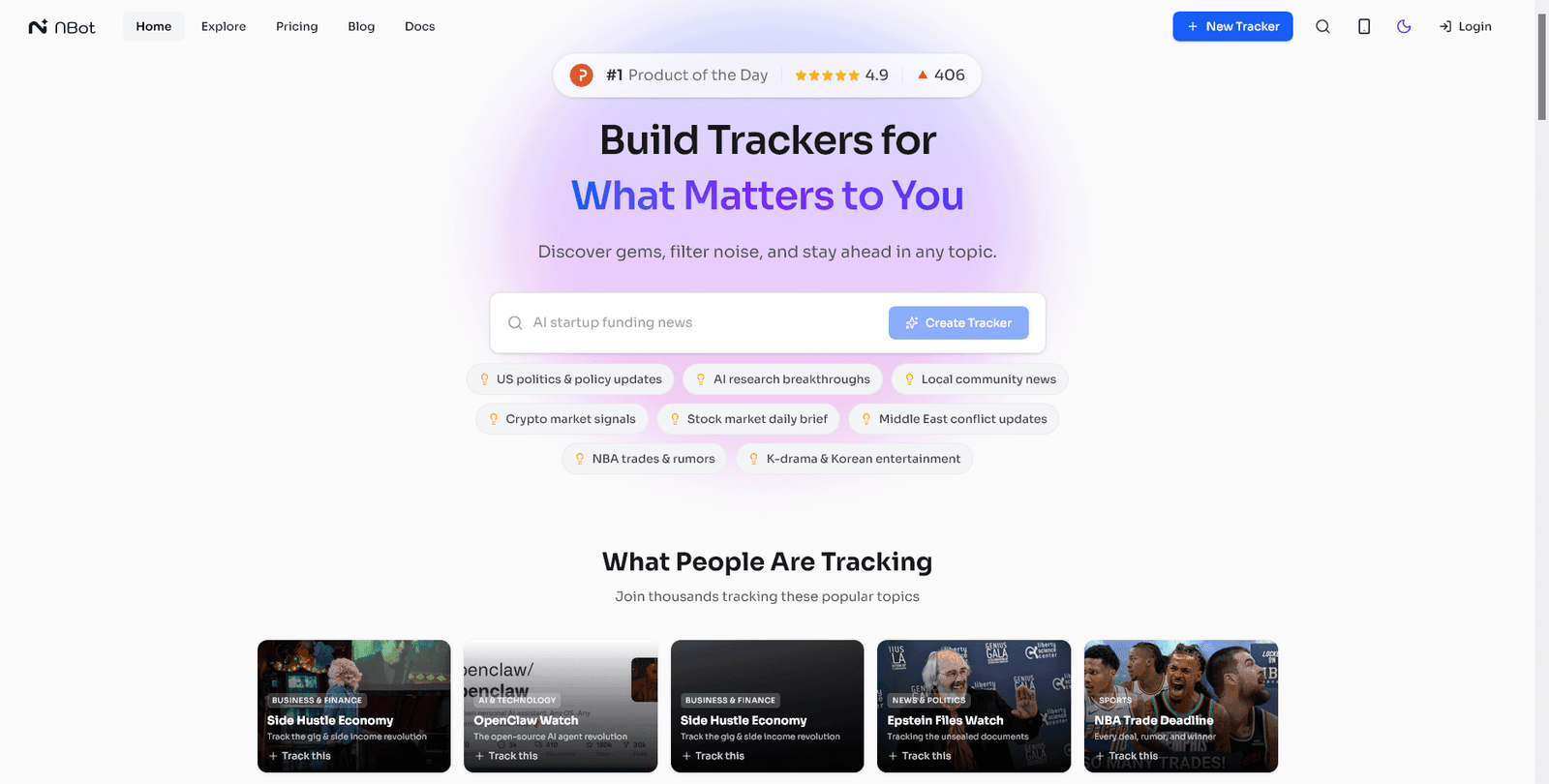
Tired of drowning in endless news feeds, blogs, and AI updates? NBot aims to solve information overload with AI-powered topic tracking and smart summaries tailored to your interests. Instead of manually scanning dozens of sources, NBot continuously monitors the web, filters the noise, and delivers concise insights through personalized “Curators” and conversational feed chat. In this review, we explore its features, pricing, strengths, limitations, and whether it’s a smarter alternative to traditional news aggregators and RSS tools.
Overview
NBot is an AI-powered content tracking and summarization platform designed to help users monitor specific topics across the web. The tool continuously scans sources such as news websites, blogs, forums, social platforms, videos, and articles, then surfaces summarized insights based on user-defined interests.
Unlike traditional RSS readers or keyword alerts, NBot focuses on semantic understanding rather than simple keyword matching. Users can create personalized “Curators” in natural language, allowing the AI to understand nuanced topics, filter irrelevant information, and generate concise summaries of emerging trends and discussions.
The platform is aimed at researchers, analysts, professionals, founders, marketers, and enthusiasts who need to stay informed without manually reviewing large volumes of content daily.
What Is NBot?
NBot is essentially an AI-driven information aggregation and summarization engine. It combines content discovery, filtering, and AI summarization into a single workflow.
The platform monitors the web continuously and delivers curated updates based on topics users define in plain language.
For example, users could track:
- AI regulation developments
- Startup funding news
- Cybersecurity incidents
- Industry trends
- Competitor activity
- Emerging technologies
- Scientific research topics
NBot attempts to reduce information overload by surfacing only the most relevant content while generating summaries that explain why a topic matters.
Key Features
AI-Powered Topic Tracking
NBot continuously scans multiple web sources including:
- News sites
- Blogs
- Forums
- Articles
- Social platforms
- Images
- Videos
Instead of relying solely on keyword matching, the platform uses AI to understand context and topic intent.
This allows users to create highly specific monitoring feeds without building complex search filters.
Personalized “Curators”
One of NBot’s standout features is its custom “Curators.”
Users can describe topics naturally, such as:
- “Track AI startup funding in Europe”
- “Monitor cybersecurity breaches affecting healthcare”
- “Follow developments in open-source LLMs”
The AI then builds a personalized monitoring stream around those interests.
This approach makes the platform more accessible than traditional research monitoring tools that require advanced Boolean search logic.
AI Summaries
NBot generates concise summaries for discovered content rather than simply listing links.
The summaries aim to explain:
- What happened
- Why it matters
- How it relates to tracked interests
- Key takeaways
This can significantly reduce the time needed to scan large information streams.
Conversational Feed Chat
The platform also includes a “Feed Chat” capability that allows users to query tracked information conversationally.
Instead of manually searching through saved articles, users can ask questions about their curated feeds and receive synthesized responses.
This feature moves NBot closer to becoming an AI research assistant rather than just a content aggregator.
Noise Reduction and Filtering
One of the biggest challenges with monitoring tools is information overload.
NBot attempts to filter out irrelevant or repetitive content automatically by learning user interests and prioritizing higher-signal information sources.
This may improve relevance over time compared to static feed readers.
Podcast and Focused Feed Delivery
According to available descriptions, NBot can also deliver updates in alternative formats including:
- Focused feeds
- Digest-style updates
- Podcast-like summaries
This makes the platform more flexible for users who prefer audio or summarized briefing formats.
User Experience
NBot appears designed with simplicity in mind. The ability to define interests in natural language lowers the barrier for non-technical users who want advanced monitoring functionality without configuring complex filters.
The interface positioning suggests a workflow centered around:
- Creating topic curators
- Receiving filtered content updates
- Reviewing summaries
- Interacting conversationally with tracked data
This streamlined approach may appeal to busy professionals who need fast insights rather than raw information streams.
NBot Use Cases
Market Research
Businesses can monitor competitors, industry shifts, customer sentiment, and emerging technologies.
AI and Tech Monitoring
Researchers and AI enthusiasts can follow rapidly evolving topics without manually scanning dozens of websites daily.
Content Discovery
Writers, journalists, and marketers can use NBot to identify trends, stories, and niche discussions relevant to their audiences.
Academic and Professional Research
Professionals tracking policy changes, regulations, scientific developments, or specialized industries may benefit from summarized updates and topic filtering.
Pros and Cons
Pros
- Natural language topic tracking
- AI-generated summaries save research time
- Multi-source content aggregation
- Personalized filtering and curation
- Conversational feed interaction
- Useful for trend monitoring and research workflows
- Freemium pricing lowers entry barrier
Cons
- Public details about data sources remain limited
- Accuracy of summaries may vary by topic complexity
- Heavy reliance on AI filtering could occasionally miss niche content
- Limited transparency regarding enterprise integrations
- Advanced users may want deeper customization controls
Pricing
| Plan | Pricing Model | Notes |
|---|---|---|
| Free Tier | Freemium | Basic access available |
| Paid Plans | Not fully disclosed publicly | Likely expanded usage and advanced features |
Users should visit the official website for current pricing and plan availability.
NBot vs Alternatives
| Tool | Primary Focus | Strength |
|---|---|---|
| NBot | AI-powered topic tracking | Personalized semantic curation |
| Feedly AI | News aggregation | Enterprise intelligence workflows |
| Perplexity | AI search | Real-time answer generation |
| Google Alerts | Keyword monitoring | Simplicity and free alerts |
| Artifact (legacy concept) | AI news personalization | Consumer-focused discovery |
NBot differentiates itself through conversational feed interaction and AI-generated topic curation rather than simple keyword tracking.
Performance and Practical Value
For users overwhelmed by fragmented information streams, NBot offers a more intelligent alternative to traditional RSS readers and alert systems.
The platform’s strongest value proposition lies in:
- Reducing information overload
- Delivering summarized insights
- Personalizing content discovery
- Monitoring evolving topics continuously
However, users handling highly sensitive or mission-critical research should still verify source accuracy independently, as AI-generated summaries may occasionally omit context or nuance.
Who Should Use NBot?
Recommended For
- Researchers
- Analysts
- Startup founders
- Journalists
- Marketers
- AI enthusiasts
- Professionals tracking fast-moving industries
Less Suitable For
- Users needing strict source verification workflows
- Teams requiring advanced enterprise integrations
- Users wanting fully manual feed customization
Final Verdict
NBot combines AI-powered content aggregation, semantic topic tracking, and automated summarization into a streamlined research assistant platform.
Its natural language “Curator” system makes sophisticated monitoring more accessible than traditional keyword-based tools, while AI summaries help reduce the time spent processing large volumes of information.
Although some platform details and pricing transparency remain limited, NBot shows strong potential for professionals and researchers looking to stay informed efficiently across rapidly evolving topics.
For users seeking a smarter alternative to RSS readers, Google Alerts, or manual web monitoring workflows, NBot offers a practical and modern AI-driven solution.
Overall Rating
| Category | Rating |
|---|---|
| Features | 4.4/5 |
| Ease of Use | 4.5/5 |
| AI Summarization | 4.3/5 |
| Research Utility | 4.4/5 |
| Customization | 4.0/5 |
| Value for Money | 4.2/5 |
Final Score: 4.3/5
PromptGuard Review 2026: AI Prompt Firewall for LLM Security
Frequently Asked Questions
What is NBot?
NBot is an AI-powered platform that tracks, filters, and summarizes web content based on personalized topics and interests.
How does NBot work?
Users create AI “Curators” describing topics they want to follow. NBot scans the web continuously and delivers summarized updates relevant to those interests.
Is NBot free?
NBot offers a freemium model with free access available. Full paid plan details are not widely disclosed publicly.
Can NBot summarize articles?
Yes. The platform generates concise AI summaries explaining key developments and why they matter.
Who is NBot best for?
It is best suited for researchers, analysts, professionals, and anyone monitoring fast-moving topics online.